

Members
Group

Logo Designed by
Morgan Anderson


Public
Page
Flag Alpha
Divers Below
Clydebank Sub Aqua Club Celebrates 65 years

Clydebank Sub Aqua Club celebrated its 65th Birthday with a Dinner at the Clydebank & District Golf Club on Saturday 3rd October 2026. The event, brilliantly organised by Chairman John Kerr, was attended by a large number of current members, several partners, former members and friends.
John gave a short speech before the buffet style dinner was served by the Golf Club staff. In his speech John referred to the long history of the Club and the regular programme of diving trips, including the weekend trips and annual excursions to places such as the Sound of Mull and the Summer isles and various other weekend activities.
John also thanked the members of the Committee who have run the Club over these many years. In particular John singled out our Club Treasurer Michelle Morgan. Michelle has been Treasurer for the last 27 years no-less! Throughout that time there have been many issues for her to attend to which affected the Club’s financial well-being. Michelle has dealt with these issues in a calm, professional and reassuring manner. A BIG thank you to Michelle. However, she now wishes to pass on her quill pen and Accounts book to someone else at the next Club AGM, so any takers??
John also produced a looping photo/video clips presentation which showed members past and present, plus some photos & video clips of marine life. Thanks to everyone who contributed to this presentation.
The celebration was a great opportunity to catch up with former members and become acquainted with the newer members. Of course, throughout the evening there were many tales of diving adventures and “daring-do” in our underwater world, plus a few laughs at how young we all were and how strange some of our diving gear looked!!!
A very BIG thank you to John Kerr for organising the event and to everyone who attended to make it a very successful evening. Here’s to the next 65 years! What will the equipment look like then I wonder?
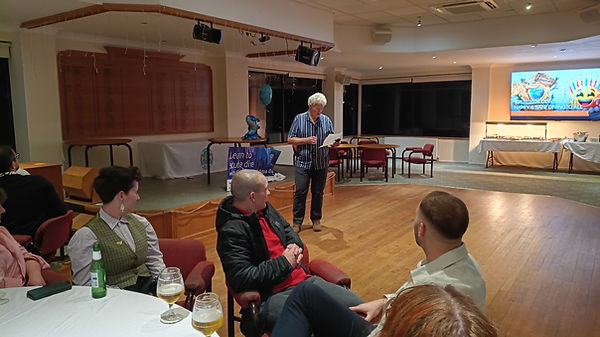


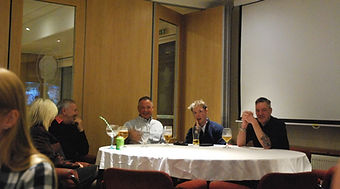


Thanks to Helena Fox for the selection of Photos
Clydebank Sub Aqua Club at 65
Clydebank Sub Aqua Club started life in October 1961, so 2026 is our 65th Anniversary year. In 2021 Jack Morrison wrote a great article remembering some of the history of Clydebank Sub Aqua Club. It is reprinted now and I have added a short supplement to bring us up to date.
Memory is a funny thing. I remember clearly the night Clydebank branch was formed but I can’t remember the exact date other than it was 1961. A group of about thirty met in the Central Library a mixture of locals, some of whom were already divers and members of Ibrox branch, looking to start a branch closer to home. Frank Galloway, the General Secretary and Peter Bell, President of the Scottish Sub Aqua Club, came along and showed films and slides of outings and even some underwater shots. That was followed by a pool session with try dives for prospective members. Sadly, not me or my chums, at fifteen we were too young to use an aqualung. They allowed us to join as junior members and we spent the next year learning to snorkel and perfecting our finning technique, I’m still trying to get it right. In those early days we had no equipment and no money but some of those who transferred from Glasgow branch had their own equipment and we managed to acquire a couple of demand valves in need of repair. Over the next two years we built up a bank of equipment, mostly cylinders, working on the premise a demand valve can be used by many but a cylinder only once.
Transport was also in short supply as in those days few people owned cars. One of our regular sites was Red Rocks just outside Largs. Eddie Docherty would put ten or twelve cylinders in his Ford Anglia and drive down while the rest of us would wear our weight belt carry our bag on the bus to Glasgow catch the train to Largs then the bus out to Red Rocks. As more members joined with cars we went further afield, Loch Long, Loch Fyne, St Abbs and Oban. Oban was a favourite as Oban branch had a hut with a compressor and could fill cylinders but only after church services were finished at two o’clock. They say people make Glasgow and the same applies to diving clubs. We were fortunate during those early years to have some memorable characters whose selfless dedication helped the club thrive. By 1969 we had over 100 members. Characters like our first BDO Eddie Docherty a Physical Training Instructor during the war he was always pushing us to extend our skills. In those days we all learned to do free ascents one from ten feet, one from 20 feet and one from 30 feet. Eddie turned it into a competition adding 10 feet at a time until we were all happily doing free ascents from 100 feet or 30 metres. Thankfully we don’t do free ascents anymore, it’s scary and dangerous and with modern equipment unnecessary. There was our unofficial Safety Officer Jimmy Duff, so called because he neglected his equipment. There was verdigris on the metal parts, tears in his suit all because he never took it out of the boot of his car except to go diving.


Alan McCormack, who said his first dive was off the front of a landing craft on D-day. They were told they were in shallow water when they were in fact in 4 metres Alan survived because he was a swimming instructor but not all of his fellow soldiers did. Jimmy Sinclair, a canny treasurer, who built up our funds and went on to be Treasurer of the Scottish Sub Aqua Club (ScotSAC). Ali Abubakar, who built an artificial reef in Loch Long which attracted congers and is still called “Conger alley” but should be “Ali’s reef” as it once was. Adam Curtis joined in 1967 when he was appointed professor of Cell Biology at Glasgow University. Clever, yes, clumsy, yes, evidence lots of broken masks, other peoples usually. Then there was the time on Bruce Howard’s boat when Bruce asked Adam to deploy a stern anchor which he duly did. We all watched as the end of the rope disappeared over the stern. “Did you not secure it before you threw it over?”
“No”
Adam spent his first dive looking for the lost anchor. He did recover it. There are so many stories of loss and finding. The most difficult was finding Eddie Docherty’s false teeth in Oban bay when he surfaced started laughing and his top set fell out. We found them eventually. Everything was simpler then. Most of us had wet suits repaired easily with Evo-Stick. Cylinders didn’t hold enough air to allow us to stay deep enough or long enough to need decompression stops. There were very few rules, one which came in handy was the requirement for surface cover. There was a joint outing at Troon harbour with a navigation competition. Dive pairs had to navigate a square course. Each pair had to have surface cover to follow them. Clydebank were the only pair who realised if they swam on their backs, they could follow the snorkel cover who went straight from one buoy to the next round the course. No-one noticed neither of divers had a compass!!


Those were exciting days when everything was new, dive sites were being explored for the first time. I still put my gear together before I put my suit on, a throwback to those days when o-rings were nylon and failed, often ruining a days diving. Today the branch is in excellent shape there is a good committee and the members keep in touch through social media. There is more diving and training being carried out than ever. Sometimes I wish I was starting out again as a spotty fifteen your old looking forward with anticipation and excitement to my first dive. Eddie used to write a short column for our local paper where he used his imagination rather than his log book to describe diving. “Hovering weightless above the seabed we followed the spoor of some unknown denizen of the deep”. We had a good laugh at that one. Happy birthday Clydebank Sub Aqua Club. (Jack Morrison)


Continuing the story to 2026, in late 2021/22, after long negotiations and discussions, members of Clydebank Sub Aqua Club voted to become affiliated to the British Sub Aqua Club (BSAC). Since then, several members have participated in the BSAC programme of Skills Development Courses and have become SCUBA Diving Instructors, Boat handlers and Compressor operators. Being the “Glasgow” Club for BSAC we have also attracted a number of new members from the Glasgow area and the surrounding suburbs. They have gone on to become “Ocean” and “Sport” Divers. A few people who have migrated to this area from south of the border have also joined Clydebanksac.


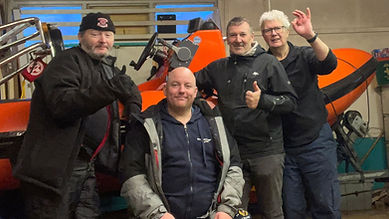
In 1961, the “state of the art” equipment consisted of twin hose demand valves, a basic aluminium or plastic backpack for mounting our scuba air tanks, surface life-jackets, 6mm wetsuits (if you were lucky), a dive watch and depth gauge. After 30 minutes underwater you would be so cold that you were glad that your air supply was running low.
65 years later “state of the art” means precision engineered single hose demand valves, Buoyancy Compensator Devices for mounting scuba tanks which now contain air or nitrox, fleece thermal undergarments and dry suits to keep you warm and dry (well, most of the time). The digital age has also brought us dive computers which will monitor every second of your dive and offer decompression advice. Post dive, you can analyse every aspect of your dive and add it to your collective experience. For those who wish to dive deeper for longer we have mixed gas Rebreathers opening up even more dive sites around the country and the world. Manufacturers have even brought a little colour to scuba diving equipment and so made it easier to see divers underwater and on the surface. The range of Diving Equipment manufacturers and retailers has also increased considerably. Many more Diving Clubs and Dive Centres have sprung up offering a great range of Diving Skills Courses.
So, what will the next 65 years bring us in the scuba diving world? Only time will tell! (Keith Waugh)

